Research
Echinoderms are a phylum of marine invertebrates comprising animals like sea stars and sea urchins – and less familiar ones such as ophiuroids, crinoids and sea cucumbers. Although being closely related to vertebrates, echinoderms stand out among animals because they have evolved a unique fivefold (also called pentaradial) symmetry, which is most obvious when looking at the body of adult sea stars or ophiuroids. This is unlike most other animals, which like you and I have a bilateral symmetry (with clear antero-posterior and dorso-ventral axes). The evolution of a fivefold symmetry, which took place during the Cambrian over 500 million years ago, makes echinoderm a unique natural experiment on body plan evolution and plasticity. The goal of our laboratory is to investigate how conserved developmental mechanisms that are shared by most animals have enabled the evolution of the unique fivefold body plan of echinoderms, and how their rewiring over macroevolutionary time frames enables the evolution of morphological novelty.
Body plan evolution in echinoderms
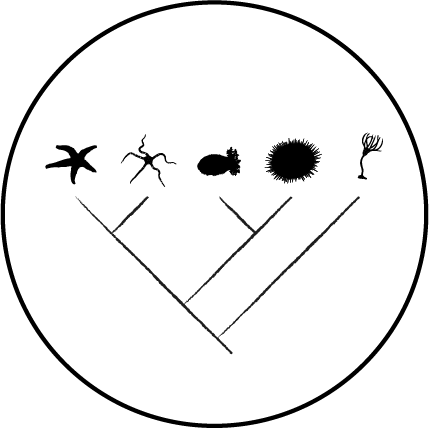
Because of their fivefold symmetry, echinoderms have been a long standing puzzle for zoologists when it comes to compare them with other animals. Recently, the discovery that developmental programs are often more conserved than the morphology they give rise to brought a solution to this issue. By surveying the deployment of conserved molecular programs, such as the molecular mechanisms involved in antero-posterior and dorso-ventral patterning of most bilaterian animals, we can build a molecular map that serves as a key to relate echinoderm anatomy with the axial coordinates of their bilateral relatives. Within echinoderms, this approach also helps to clarify the relationships between the different classes of the phylum. Indeed, although echinoderms are united by their fivefold symmetry, they exhibit vastly divergent morphologies. By exploring molecular patterning across echinoderms using in situ hybridization and transcriptomic approaches, our goal is to reconstruct the evolution of these developmental programs during the evolution of the fivefold symmetry at the stem of the phylum, but also during the later radiation of echinoderm classes.
Bilateral to pentaradial transition
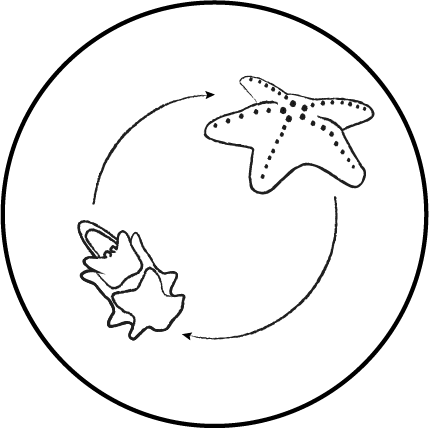
One remarkable thing about echinoderms is that they don’t start their life as pentaradial animals – instead, their embryos and larvae are bilateral, exactly like the ones of their relatives. This means that each echinoderms, during its lifecycle, transition from bilateral to pentaradial symmetry during a complex developmental process known as metamorphosis. The formation of an adult body plan by transformation of a larva is rather common among animals, in particular within marine invertebrates. However, the extent to which echinoderms transform their larval body into a pentaradial adult is unmatched in other animals, setting echinoderms as an excellent group to study how adult body plan development can occur by remodeling of existing larval tissues. Using live imaging and transcriptomic approaches, our goal is to decipher the cellular and molecular mechanisms involved in metamorphosis in echinoderms, which are still largely unknown.
Genetic control of adult body plan development
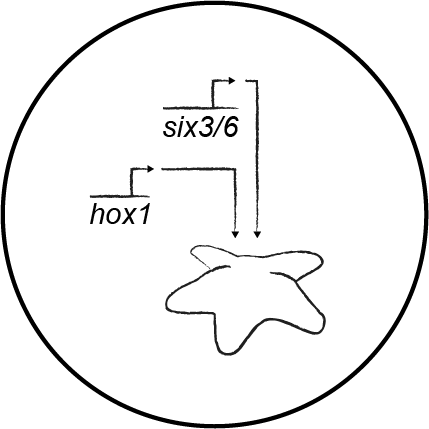
The function of patterning programs such as the antero-posterior and dorso-ventral programs is to set up distinct territories along their respective axes, which are used by the embryo as a coordinate system to build the appropriate structure. For example, during vertebrate development the antero-posterior patterning program regionalizes the ectoderm into distinct regions that develop into forebrain, midbrain, hindbrain and spinal cord – the main territories of our central nervous system. The molecular wiring of these molecular programs is strikingly remarkably similar across most bilaterian animals, from fruit flies to annelid worms and vertebrates. However, although these animals are distantly related, they all follow the basic blueprint of bilateral symmetry. On the other hand, the function and the molecular logic of these programs when forming a pentaradial body plan remains unknown. Our goal is to use the genetically tractable sea urchin Lytechinus pictus to manipulate these programs during the development of the unique pentaradial body plan of echinoderms, and determine how conserved is the regulation and function of key patterning programs when building a non-bilateral body plan.
Our funding
Header picture: Acetylated-tubulin stainings in optically clearead sea star (Patiria miniata and Henricia sp.) juveniles.